They Couldn't Buy Him. So They Bought His Seat.
Thomas Massie put the PRIME Act in the Farm Bill nineteen days before $32.6 million in foreign lobbying money ended his career. The movement that just won a legislative victory lost its only legislator. What comes next is on us.
Thomas Massie put the PRIME Act in the Farm Bill nineteen days before $32.6 million in foreign lobbying money ended his career. The movement that just won a legislative victory lost its only legislator. What comes next is on us.
Before dawn on a northeast Kentucky farm, cattle need moving. No algorithm decides that. No federal inspector signs off on the morning. A man in boots does it, same as his grandfather did, because the land and the animals require it. Thomas Massie has done that work for over two decades. He has also, for thirteen years, done a different kind of work — the kind done in committee rooms and on House floors, where the rules that govern what happens to those cattle after they leave the pasture get written.
On April 30, 2026, both kinds of work converged. The House of Representatives passed the Farm Bill — the Farm, Food, and National Security Act of 2026 — by a vote of 224 to 200. Buried inside, as Section 12114, was the pilot program for the Processing Revival and Intrastate Meat Exemption Act — the PRIME Act. Massie’s signature legislation. The bill he had introduced and reintroduced in every Congress since 2015. The bill the meatpacking industry had spent a decade quietly killing.
Massie voted yes. He put out a press release. He said what ranchers had been waiting to hear: “Consumers can soon expect increased access to locally raised and processed beef, pork, and lamb sold directly from farmers, and farmers will no longer be burdened by the hefty and costly USDA constraints that force them to drive hundreds of miles with their animals to the few and sparse USDA facilities.”
Nineteen days later, he was gone.
What the PRIME Act actually does — and why it mattered
The federal meat inspection system, as currently structured, is a bottleneck with a flag on it. Under the Federal Meat Inspection Act, any beef, pork, or lamb sold commercially must pass through a USDA-inspected facility. There are not many of those. The ones that exist are largely controlled, directly or through contract relationships, by the four companies that process roughly 85 percent of American beef: JBS, Tyson, Cargill, and National Beef. The independent rancher who wants to sell a side of beef to the restaurant twenty miles away cannot do it legally without routing through a system designed for industrial-scale throughput — a system that treats his 40-head operation the same as a plant processing 5,000 head a day.
That is not food safety. That is cartel infrastructure wearing a USDA badge.
The PRIME Act changed the architecture. It exempted custom-slaughter facilities from federal inspection requirements for intrastate sales — meaning a state-licensed processor could sell directly to consumers, restaurants, hotels, grocery stores, and boarding houses within the same state, without running the product through a Big Four plant. State and local inspectors — the same people who inspect restaurant kitchens — would provide oversight. The bill carried 45 bipartisan cosponsors in its 119th Congress iteration. It had the same number of enemies it always had: the companies who profit from the bottleneck.
The pilot program that made it into the Farm Bill caps participation at five facilities per state, with room to expand if no safety issues emerge. Critics on the independent-rancher side have noted the cap is too restrictive — particularly for large states like Texas. They are right. But a pilot is a door. Massie had spent a decade trying to get a foot in one. On April 30, he got it.
The machinery of removal
Five days after the Farm Bill passed the House, Massie introduced H.R. 8809 — the Americans Insist on Political Agent Clarity Act. The AIPAC Act. It would amend the Foreign Agents Registration Act of 1938 to require organizations whose lobbying principally advances a foreign nation’s diplomatic or economic interests to register with the Department of Justice as foreign agents. It cited legal precedent. It included a private right of action. It named no names in its text and did not need to.
The timing was not subtle. It was not meant to be. AIPAC’s super PAC, the United Democracy Project, had already spent $4.15 million in independent expenditures against him. The Republican Jewish Coalition Victory Fund had committed $3.87 million. A new PAC called MAGA KY — its finances not fully disclosed but its top known funder being Paul Singer, a pro-Israel billionaire who had also given $2.5 million directly to UDP — had spent $7.5 million. The total anti-Massie outside spending: over $15.8 million, according to Federal Election Commission reports.
Massie said publicly that 95 percent of the money against him came from pro-Israel lobbying sources. He said it plainly, from the House floor, in press conferences, in interviews. He named Singer. He named Miriam Adelson. He named John Paulson. He introduced a bill requiring disclosure of the very machinery being used to dismantle him.
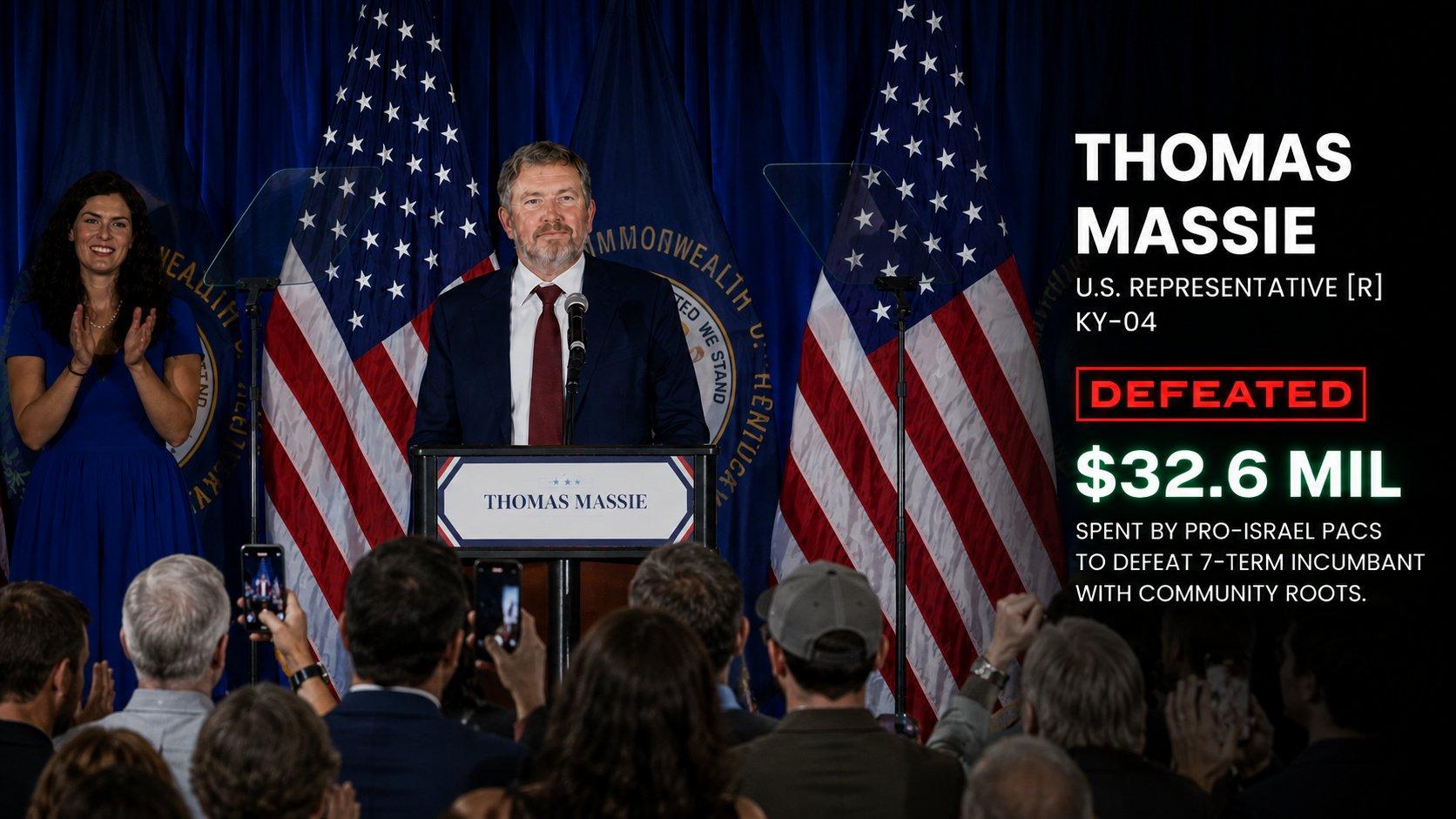
According to AdImpact tracking, total ad spending in Kentucky’s 4th Congressional District reached $32.6 million — the most expensive House primary in the 250-year history of the United States Congress. Massie said so himself on election night. His opponent, former Navy SEAL Ed Gallrein, raised $3.16 million through his own campaign committee. The ratio is not a number. It is a statement of intent.
The result: Gallrein 55 percent, Massie 45 percent. When Massie came out to concede, he told the crowd he would have appeared sooner, but it took a while to find Gallrein in Tel Aviv. The crowd laughed. Then they chanted “No more wars.” Then they chanted “2028.”
The man who put the PRIME Act in the Farm Bill walked off the stage.
Two cartels, one problem
Here is what deserves to be said plainly, because no one in the agricultural press will say it: the architecture of foreign lobbying influence and the architecture of meatpacking monopoly require the same conditions to survive. They both need a Congress that does not ask hard questions. They both need legislators who can be bought, managed, or removed. They both collapse if enough independent-minded people in positions of institutional power refuse to play along.
Massie refused to play along on both fronts. He introduced PRIME Acts. He voted against foreign aid packages. He filed FARA amendments. He opposed the consolidated inspection system and the consolidated lobbying system with equal stubbornness. That is not a coincidence of personality. It is a coherent worldview: power concentrated in any single institutional hand — a four-company meatpacking cartel, a foreign-interest lobby exempt from disclosure laws — is power that has stopped serving the people it claims to represent.
The people who benefit from that concentration understood the threat he represented. They acted accordingly.
What is remarkable is not that they removed him. That is what those systems do when they identify a genuine threat. What is remarkable is that it took $32.6 million to do it. In a safely Republican district. Against a seven-term incumbent with deep community roots. Against a man who raised cattle before he ever took a vote.
That number is not a measure of their power. It is a measure of his.
The pilot is still in the bill
Here is what the foreign money could not buy: the PRIME Act pilot is still in the Farm Bill. It passed the House. It now moves to the Senate. The Senate version will be harder. Senator John Boozman has said he wants a committee markup in weeks, not months. The road is not clear. The 2018 Farm Bill extension expires September 30, 2026. The political window is narrow and the opposition is real.
But the pilot — Section 12114 of H.R. 7567 — exists. Five facilities per state. Intrastate direct sales. State and local inspection authority. Labeling requirements. Humane slaughter compliance. A door, cracked open, for the first time in the history of this fight.
The man who forced that door open will not be in Congress when it finishes swinging. That is the reality. The question the movement has to answer — the ranchers, the processors, the consumers who understand what’s at stake — is whether the door closes with him, or whether enough people push through it to make his absence irrelevant.
What comes next is not about one man
Massie’s crowd chanted “2028.” It is understandable. He walked out of this with his integrity intact, which is more than can be said for most of the people who spent $32.6 million to defeat him. There will be pressure to draft him into something — a Senate race, a presidential run, a figurehead role for whatever coalition is assembling itself out of the wreckage of the old party structures.
But the lesson of May 19, 2026 is not that the movement needs Massie back. The lesson is that the movement cannot afford to concentrate its survival in any single legislator again. That is the same error it criticizes in the meatpacking system — all capacity routed through four bottlenecks. The answer to a concentrated system is not a concentrated champion. It is distributed infrastructure.
That means the Senate fight for the Farm Bill PRIME Act pilot. It means building out state-level processing capacity so that when — not if — the pilot becomes permanent law, the facilities exist to use it. It means BeefMaps.com, which connects consumers directly to ranchers selling outside the consolidated system, growing the demand side of the equation while the supply side catches up. It means documenting every custom facility, every local processor, every producer already operating in the spaces the Big Four cannot profitably serve.
It means understanding that the PRIME Act pilot did not win because Thomas Massie was in Congress. It won because thousands of ranchers, consumers, and advocates made the political cost of ignoring it higher than the cost of including it. That pressure does not require a single legislator to exist. It requires a movement that shows up regardless of who holds the gavel.
Thomas Massie will be fine. He has cattle to move before dawn. He has patents on file. He has a farm in northeast Kentucky that runs off the grid and does not require anyone’s permission to function.
The question is whether the people who relied on him in Washington will build something that runs the same way.
The PRIME Act outlasted the man who carried it
Every spring, cattle ranchers in states without accessible processing capacity make a calculation: how far is the nearest USDA-inspected plant, what does the haul cost, what does the wait cost, and does any of it make the direct-sale premium worth chasing. For most, the math has not worked. The bottleneck was not accidental. It was maintained, year after year, by the same institutional machinery that just spent $32.6 million on a Kentucky congressional primary.
The pilot program changes the math. Not completely. Not permanently. But it changes it — and it is sitting in the Farm Bill waiting for the Senate to decide whether independent ranchers deserve a fighting chance against the system that has been squeezing them for a generation.
Thomas Massie did not lose because he was weak. He lost because he was effective. The PRIME Act pilot is the proof. The $32.6 million is the confirmation.
What the movement does with that proof — in the Senate, in state legislatures, in the processing facilities being built right now in states that do not want to wait for Washington — is the only question that matters.
They couldn’t buy him. They bought his seat instead.
Now build something they cannot buy.
More in Farm Policy
-
 chevron_right
One farmer, one file, one surveillance contract: Palantir and USDA join forces.
Apr 26, 2026 · Beef News
-
 chevron_right
Michigan loses 100,000 acres of farmland — in 2024 alone!
Mar 23, 2026 · Breeauna Sagdal
-
 chevron_right
The Green Shoot America Can't Afford to Miss
Mar 10, 2026 · Beef News
-
 chevron_right
Break Up the Bottleneck: Washington Finally Notices the Meat Cartel — Right as America Runs Out of Cattle
Mar 7, 2026 · Beef News