The Supply Shock Is Real. The 40-Year Cartel Is What Bloomberg Missed.
The DOJ confirmed on May 4, 2026 that the Big Four meatpackers — controlling 85% of U.S. beef processing — are under active antitrust investigation, with 3 million documents reviewed and criminal tracks running parallel to civil. Bloomberg's supply-shock narrative explains today's prices. Forty years of structural concentration explains who pays for them tomorrow.
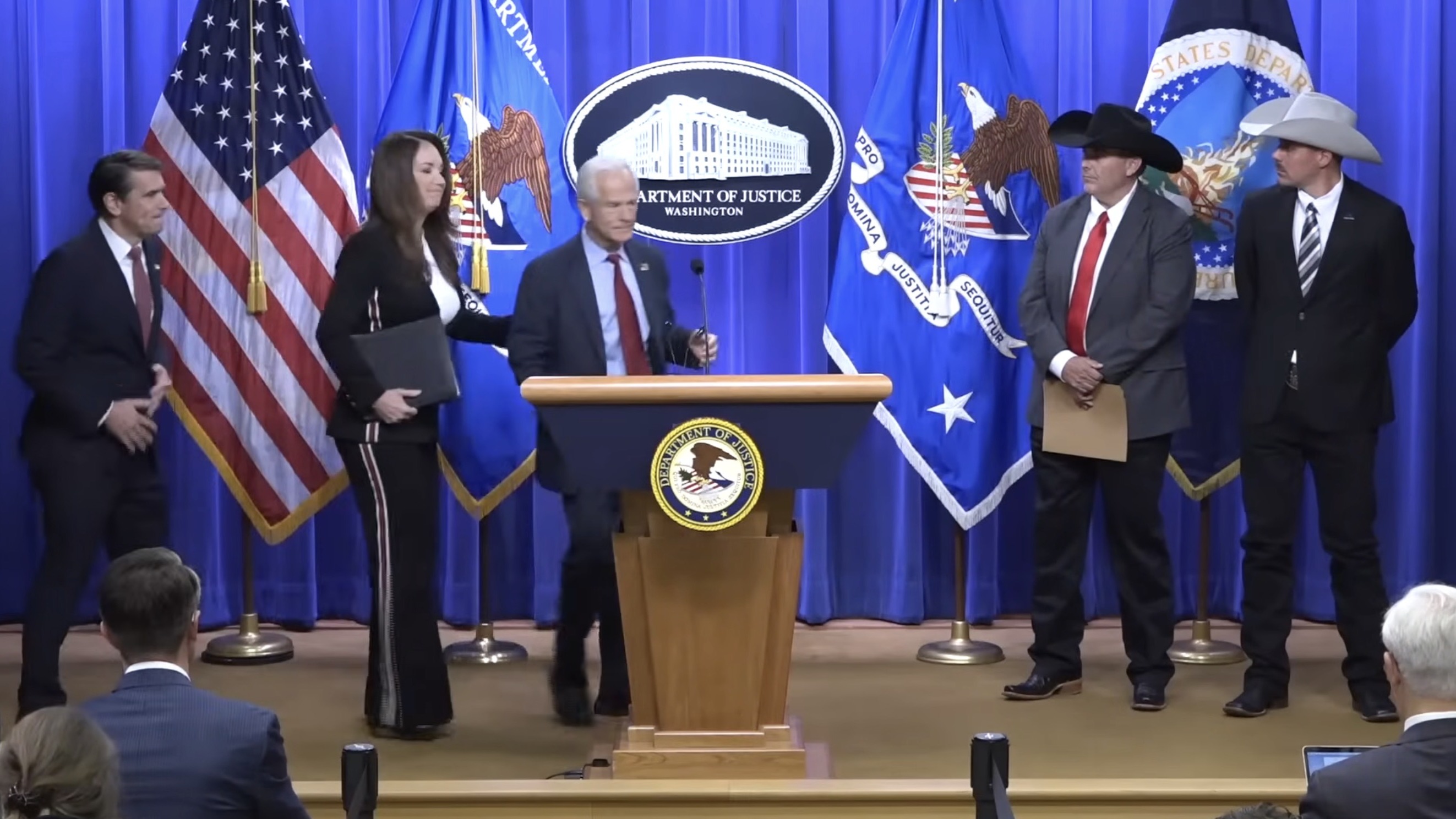
Acting AG Todd Blanche, Secretary Brooke Rollins, and Trade Director Peter Navarro at the DOJ press conference, May 4, 2026.
On May 4, 2026, Acting Attorney General Todd Blanche stood at a Justice Department podium flanked by Agriculture Secretary Brooke Rollins and Trade Director Peter Navarro and said the quiet part out loud. “The current market structure and high concentration in the industry indicate anti-competitive activity.”
That sentence is not an allegation. It is the official position of the United States Department of Justice.
The targets are not mysterious. Tyson Foods, Cargill, JBS, and National Beef — the Big Four — control over 85% of the beef processing market. Two of them answer to Brazilian ownership. All four have spent decades consolidating the infrastructure American ranchers depend on to bring cattle to market, then pricing that access on their own terms.
Bloomberg ran a piece this week explaining why beef prices are near $7 a pound. The argument: historic cattle herd contraction, drought, biology. Supply shock. Packers are losing money right now — the Sterling Marketing Beef Profit Tracker confirmed losses of $188 per head for the week ending April 25, 2026. Tyson’s own Q2 2026 earnings posted hundreds of millions in beef-segment losses.
Bloomberg is not wrong about 2026. Bloomberg is wrong about the decade.
What the Snapshot Misses
The cattle cycle is not new. Contraction, expansion, repeat. What is new — and what no supply-shock story explains — is who captures the gains and who absorbs the losses across the full cycle.
The USDA NASS January 2026 Cattle Inventory Report confirms 86.2 million total head of cattle — near a 75-year low — with the 2025 calf crop at 32.9 million head, the smallest since 1941. Secretary Rollins confirmed from that same data that the United States is at its lowest head of beef cows since the 1950s and has lost more than 17% of its cattle ranchers. That number is not a weather event. It is the terminal output of 40 years of structural consolidation that systematically removed ranchers’ marketing options, suppressed the cash market, and concentrated pricing power inside four boardrooms.
The USDA ERS Meat Price Spreads dataset — updated April 10, 2026, running from 1970 to present — documents what happens to farm-to-wholesale and wholesale-to-retail spreads across the full cattle cycle. The pattern is consistent: ranchers recover modestly in contraction phases when cattle are scarce and prices spike. Packers and retailers capture disproportionate margins in expansion phases when cattle are plentiful and farm-gate prices collapse. The cycle resets. The concentration does not.
More than 665,000 beef operations have exited since 1980 — roughly half the industry. Another 106,000 disappeared between 2017 and 2022 alone, per USDA Census data. These are not operators who chose a different career. These are producers who ran the math on a market where four buyers set the price and decided the math did not work.
The Mechanism the DOJ Named
Blanche confirmed the DOJ has reviewed more than three million documents and interviewed hundreds of industry participants as part of the probe, which is examining whether market concentration has driven higher beef prices. The investigation runs civil and criminal tracks in parallel. If criminal intent is found, Blanche said, it will be prosecuted accordingly.
The Agri Stats case — a civil action filed in September 2023 in the U.S. District Court for the District of Minnesota — illustrates the mechanism precisely. The DOJ lawsuit alleged that meat companies used Agri Stats reports to push up exports, reduce domestic supplies, and drive up costs for food companies, retailers, and consumers. A bench trial was set to begin May 18, 2026. Blanche confirmed a settlement is forthcoming that would address the business model allowing competitors to share sensitive pricing and production data — a practice he said contributed to higher prices across chicken, pork, and turkey as well.
That is not price discovery. That is price coordination dressed in a spreadsheet.
Rollins described 70 subsidiary companies owned collectively by the Big Four, a structure she said has created a frightening landscape for cattle ranchers by limiting marketing options and weakening negotiating power. Seventy subsidiaries. One buyer, many faces. That is not a competitive market. That is a cartel with a branding budget.
What History Says About Probes Like This
This is not the first investigation. During the COVID-19 pandemic in 2020, the DOJ began investigating Cargill, JBS, National Beef, and Tyson Foods for potential price fixing — a probe that was subsequently closed before the current administration reopened the inquiry. The pattern across the last 40 years is consistent: spread widening triggers public outrage, outrage triggers investigation, investigation produces limited structural reform or settlement, concentration resumes.
The Agri Stats settlement — if finalized — addresses a data-sharing mechanism. It does not address 85% market control. It does not restore the cash market. It does not rebuild a single processing facility.
The DOJ probe is necessary. It is not sufficient.
Supply Explains Today. Concentration Explains Every Year After It.
The USDA ERS Food Price Outlook released April 24, 2026 projects beef and veal retail prices up 6.3% for 2026, with farm-level cattle prices up 7.5%. The USDA ERS Livestock, Dairy, and Poultry Outlook for April 2026 corroborates the structural tightness. The spread between what ranchers receive and what consumers pay has never been wider on a structural basis.
More investigators will not fix this. More documents will not fix this. What fixes this is infrastructure: independent regional processing capacity, mandatory cash-market minimums that prevent formula pricing from strangling price discovery, and enforcement architecture that treats market allocation as the crime Blanche just confirmed it may be.
Ranchers are not winning this. Consumers are not winning this. The four firms controlling 85% of processing — operating behind 70 subsidiaries — are the only entities positioned to win regardless of which direction the cycle turns.
Find ranchers selling direct at BeefMaps.com.