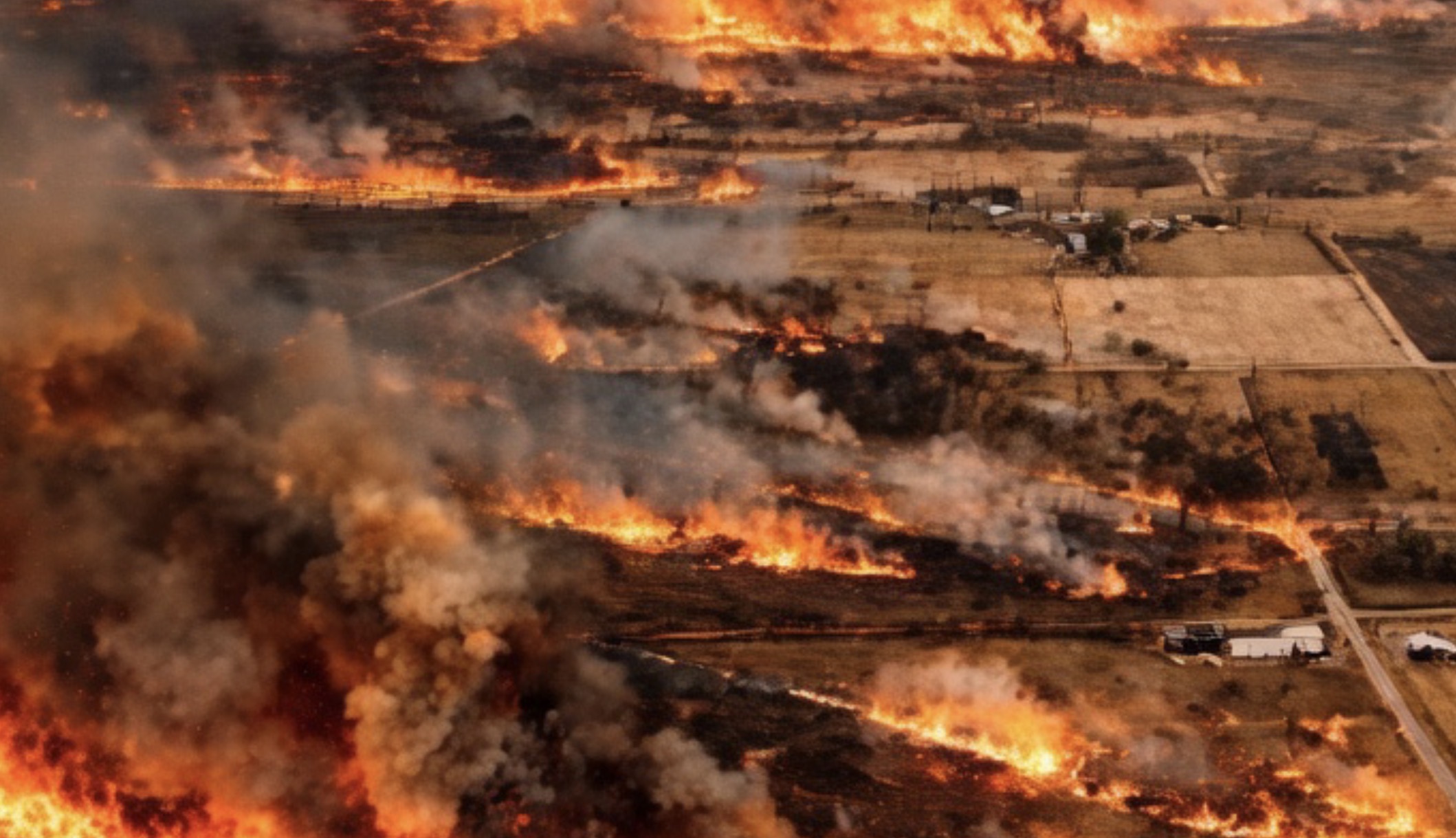
Plains on Fire: March 30, 2026 National Field Report
A real-time accounting of who is hurting, where the pressure is coming from, and where support needs to land before more operations liquidate.
| The American ranching class is under simultaneous assault from fire, drought, regulatory lawfare, predator expansion, and a packing cartel that hasn’t loosened its grip on 85% of fed-cattle slaughter in a decade. The USDA’s January 1, 2026 cattle inventory report puts the total U.S. beef herd at 86.2 million head — the smallest since 1951. Private foundations are carrying 100% of direct disaster relief. The federal architecture is not in the field. |
THE FIRES
On March 12, 2026, the Morrill Fire ignited in the Nebraska Sandhills. Within 18 hours, up to 350,000 acres burned. Combined with the Cottonwood, Road 203, and Anderson Bridge fires, the Nebraska Governor’s office confirmed nearly 827,000 total acres destroyed. The Nebraska Department of Agriculture’s own director, Sherry Vinton, put the cattle impact in plain terms: “If we say it’s roughly 600,000 acres, that’s a grazing resource for 35,000 cows.” (Rural Radio Network) Calves triaged in makeshift nurseries. Miles of fencing gone. Grazing land sterilized — in some areas described as pure sugar sand, the heat baking the soil so completely that producers may not graze again until 2027.
The Nebraska fires follow February’s Ranger Road Fire across the OK/KS Panhandle, which burned over 283,000 acres of prime cow country. The Gardiner Angus Ranch near Ashland, Kansas — a generational seedstock operation — lost approximately 90% of its grazing land and 250–300 head of cattle killed or put down. These aren’t statistics. They are the end of something that took generations to build.
All of this hits a herd that was already at a breaking point. According to the USDA January 2026 inventory, the U.S. beef cow breeding herd dropped to 27.6 million head — a level not seen since 1961. Before the fires started, before a single acre burned in the Sandhills, the industry was already in a hole. The fires didn’t create the crisis. They accelerated a liquidation that was already underway.
THE REGULATORY SQUEEZE
On March 5, 2026, the New Civil Liberties Alliance filed a motion for summary judgment in R-CALF USA, et al. v. USDA in the U.S. District Court for the District of South Dakota, asking the court to vacate USDA’s 2024 mandate requiring electronic identification eartags for all cattle and bison transported across state lines. The plaintiffs include South Dakota ranchers Kenny and Roxie Fox and Rick and Theresa Fox, alongside R-CALF USA, the South Dakota Stockgrowers Association, and the Farm and Ranch Freedom Alliance.
The NCLA’s case documentation lays the charge out plainly: USDA’s mandate adds approximately $3 per head in compliance costs while failing to demonstrate any disease-tracing improvement over the visual tags it replaced. The rule is internally inconsistent — it claims EID tags are necessary to reduce human transcription error, then permits producers to use those same EID tags exactly as they used visual tags, without electronic readers. Ranchers are simply paying more to do what they have done for decades. That is the entire policy. The Administrative Procedure Act calls that arbitrary and capricious. The court will decide.
Meanwhile, in California, the Harvey Pack has killed or injured cattle across Lassen and Plumas counties — including a calf and a horse named Smoke on New Year’s Day 2026. In Siskiyou County, the Table Rock Ranch has documented 44 or more confirmed depredations since 2021. In Jackson County, Colorado, the Meyring family lost their dog Scout — a working livestock guardian — to wolves on February 7, 2026. Colorado Parks and Wildlife depredation compensation payoutshave exceeded annual program budgets. The wolves are recovered. The ranchers are not.
THE PROCESSOR CORRUPTION
The Santa Carota Beef case belongs in a category of its own. Justin Pettit and his family built a sustainable, carrot-finished beef operation in California and Texas — a direct-to-consumer model that represents exactly the kind of independent, transparent supply chain the I Am Texas Slim Foundation exists to support. In early 2026, allegations of foreign product mixing and fraudulent order fulfillment by a processing partner surfaced, triggering a lawsuit, the loss of a 10,000-acre grazing lease, the halt of all harvesting operations, and the forced sale of cattle and equipment. The family’s GoFundMe has raised approximately $77,400 of a $90,000 goal as of late March 2026. The corruption in the processing layer — the same chokepoint the Big Four have controlled for decades — reached down and nearly destroyed a family that was doing everything right. Buy their beef at santacarota.com. That is the most direct support possible.
THE DROUGHT
In Brooks County and across South Texas, persistent drought has stripped pastures bare. Ranchers are running supplemental feed operations that were never designed to be permanent. Some have sold up to 1,000 head — not because they wanted to, but because the land cannot carry them. This is herd liquidation in slow motion. It doesn’t generate GoFundMe pages. It doesn’t produce dramatic footage. It just quietly ends ranching operations that survived the Dust Bowl, the drought of ‘88, and the collapse of 2012. The Texas Department of Agriculture Hay Hotline at (877) 429-1998 connects donors, hay sellers, and available grazing land. Use it.
WHO IS RESPONDING — AND WHO ISN’T
Every dollar of direct disaster relief moving to Plains ranchers right now is coming from private organizations. The Nebraska Cattlemen Disaster Relief Fund — 100% pass-through, zero administrative cut, confirmed by Executive Vice President Laura Field on the record — is the primary channel for Sandhills ranchers. The Kansas Livestock Foundation is coordinating hay and fencing for Ranger Road families. The Oklahoma Cattlemen’s Foundation is running 100% direct-to-producer relief for panhandle operations. The Rancher Navy — a volunteer convoy network — is moving bales across state lines, one semi at a time.
The federal government has disaster programs on paper. The USDA Farm Service Agency Emergency Loan Program and the Livestock Forage Disaster Program exist. Affected producers should contact their local USDA Service Center. But the ranchers who need hay this week are not waiting on a federal application to process. They are calling each other.
That is the story. Private foundations, volunteer convoys, and neighbor-to-neighbor hay drops are the emergency response system for the American beef producer. Rancher sovereignty is not an abstraction. It is the only thing that moved when the fires came.
HOW TO HELP
The I Am Texas Slim Foundation is coordinating relief across all active crisis vectors. To support the Foundation’s distribution effort — which directs funds to the verified operations and organizations documented in this report — donate at iamtexasslim.org/donate.
If you want to direct support to specific organizations and operations yourself, every verified channel is listed below. These are primary sources only — official organization websites, confirmed GoFundMe pages, and state agriculture portals. No intermediaries, no guesswork.
VERIFIED DIRECT SUPPORT DIRECTORY
Nebraska Sandhills / Morrill Fire
— Nebraska Cattlemen Disaster Relief Fund — 100% to producers. Mail: Nebraska Cattlemen Disaster Relief Fund, 4611 Cattle Drive, Lincoln, NE 68521-4309. Phone: (402) 475-2333. Email: disasterrelief@necattlemen.org
— Text SUPPORT to 308-254-5804 for hay drop coordination
— Nebraska Sandhills Rancher Fire Relief Fund — targeted to Sandhills producers
— Nebraska Department of Agriculture disaster resource portal — live hay and fencing spreadsheets with direct rancher connections
Kansas / Ranger Road
— Kansas Livestock Foundation Disaster Relief — Mail: Kansas Livestock Foundation, 6031 SW 37th Street, Topeka, KS 66614 (memo: “2026 Wildfire Relief”). Hay and trucking coordination: (785) 273-5115
— Ashland Community Foundation — PayPal quick link, or mail: P.O. Box 276, Ashland, KS 67831 (memo: “Ranger Road Fire Relief”). Cash drop: Stockgrowers State Bank, 622 Main Street, Ashland, KS 67831
Oklahoma / Panhandle
— Oklahoma Cattlemen’s Foundation Fire Relief Fund — 100% direct to producers. Mail: Oklahoma Cattlemen’s Foundation, P.O. Box 82395, Oklahoma City, OK 73148 (memo: “Fire Relief”)
— Oklahoma Farm Bureau Foundation Wildfire Relief — PayPal option available
Santa Carota Beef — processor corruption lawsuit
— GoFundMe — Help Save Our Family Ranch Business (~$77,400 of $90,000 raised as of late March 2026)
— Buy direct (strongest long-term support): santacarota.com
— Updates: Santa Carota Facebook page
Multi-state hay, fencing, and feed drops
— Rancher Navy — volunteer 501(c)(3), TX/OK/KS/NE convoys. Donate: ranchernavy.org/volunteeranddonate.html
— Request help / drop points: ranchernavy.org/help.html
— Real-time coordination: Rancher Navy Facebook group
Texas drought / hay
— Texas Department of Agriculture Hay Hotline — (877) 429-1998. Connects donors, sellers, available grazing land, and transport
EID mandate lawsuit — Fox family and R-CALF USA
— Donations: r-calfusa.com/make-a-donation
— Tax-deductible arm (USA FREE): r-calfusa.com/charitable-donation — Mail: USA FREE, P.O. Box 30715, Billings, MT 59107
— CEO Bill Bullard: (406) 252-2516
Wolf depredation — California
— CDFW wolf-livestock compensation program — Email: wolfcompensation@wildlife.ca.gov
Wolf depredation — Colorado
— Colorado Parks and Wildlife depredation compensation — contact your local CPW office. Program payouts exceeded annual budget in 2025–2026
| *The mission is rancher sovereignty — not as a slogan, but as infrastructure.*Support the Foundation’s ongoing work at iamtexasslim.org/donate |
The I Am Texas Slim Foundation tracks rancher crises, regulatory lawfare, and packer consolidation in real time. This field report reflects verified primary sources as of March 30, 2026.
iamtexasslim.org // beefmaps.com // beefnews.org
More in Cowboy Talk
-
 chevron_right
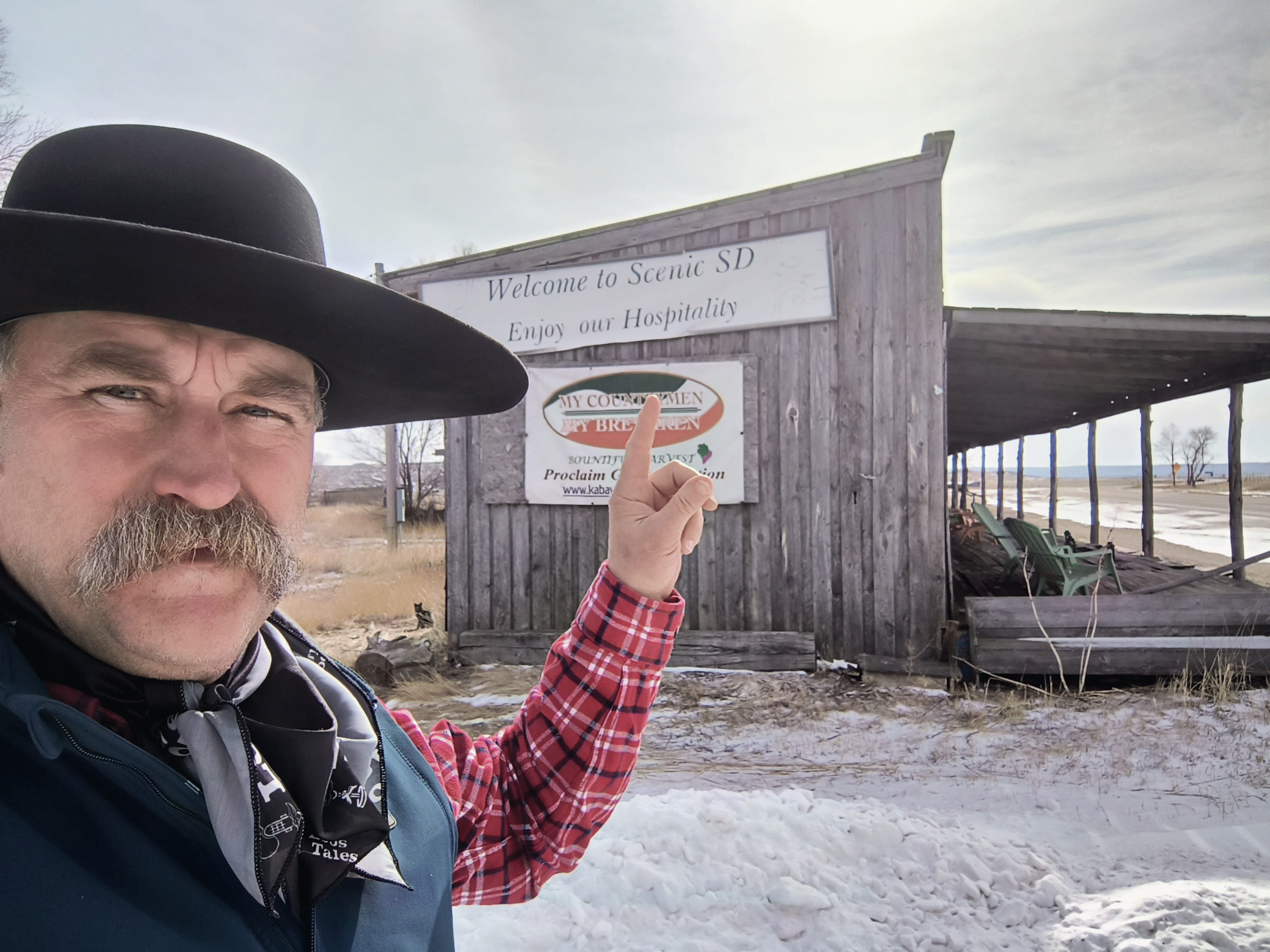
Trent Loos Exposes the Truth Behind the Maude Family Arrest: Here's What Happened
May 1, 2025 · Beef News Wire
-
 chevron_right
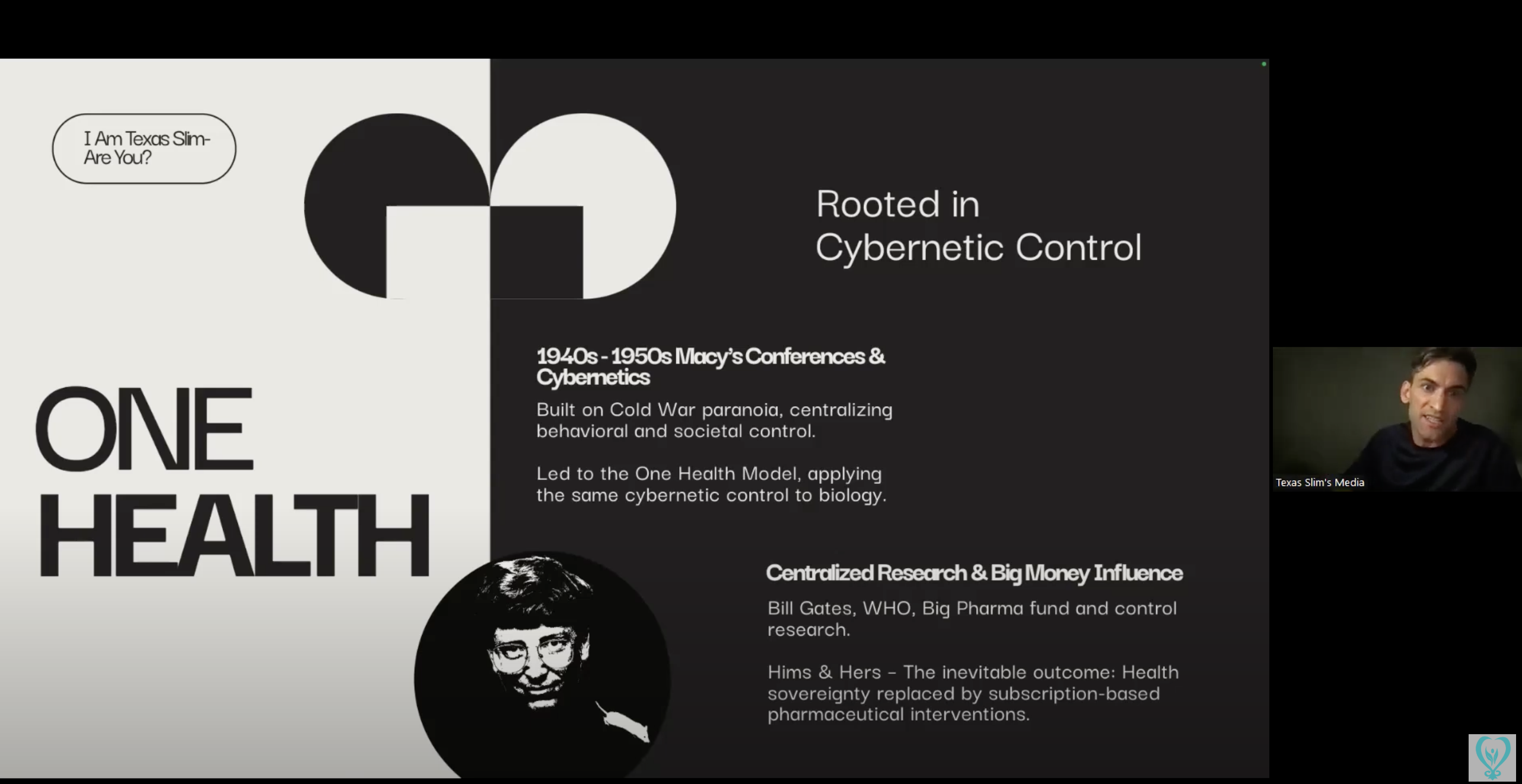
Sovereign Health vs. One Health: Ranchers and Researchers Build a New Path Forward
Apr 3, 2025 · Beef News
-
 chevron_right
Ranching Reimagined: Sovereign Health Framework vs. One Health—The Battle for Food Sovereignty
Mar 6, 2025 · Beef News
-
 chevron_right
Cattlemen United: RFID Mandates, Beef Checkoff Corruption, and the Fight to Restore American Beef
Feb 22, 2025 · Beef News