Nine Days: DOJ Names Them, Trump Family Dines With Them, White House Flies One to Beijing
Within nine days of the DOJ's public confirmation of a criminal antitrust probe into the Big Four beef processors, Donald Trump Jr. shared a stage with JBS's controlling shareholder at a Manhattan dinner while Cargill's CEO — another named subject — flew to Beijing as the administration's sole agriculture representative. The investigation is active. The access is documented. The precedent for enforcement without remedy is established.
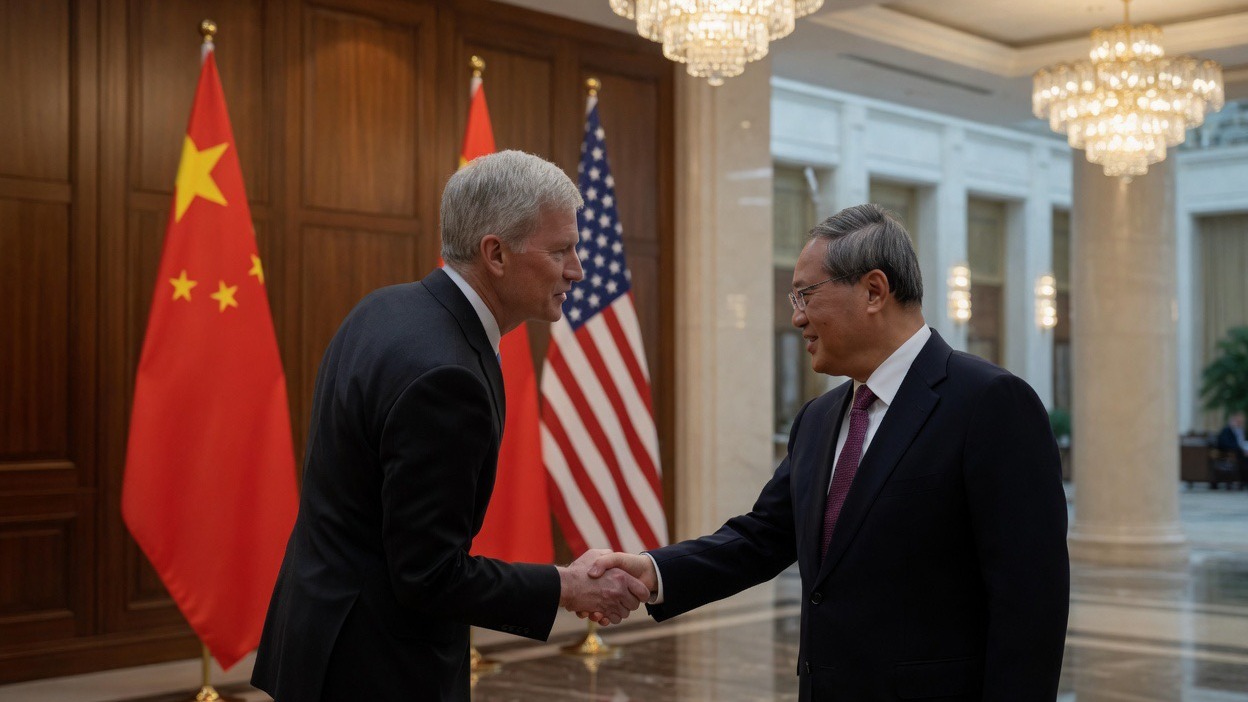
Cargill CEO Brian Sikes meets Chinese Premier Li Qiang in Beijing, March 2025. Two months later, Sikes flew to Beijing again — this time on Air Force One, as his company remained under active federal antitrust investigation. (Photo: MPR News)
On May 4, the Department of Justice stood before cameras at the DOJ press room and confirmed an active criminal antitrust investigation into the four largest beef processors in the United States. Acting Attorney General Todd Blanche named the targets outright: JBS, Cargill, Tyson Foods, and National Beef — companies that together control roughly 85% of U.S. fed-cattle slaughter capacity. Blanche announced that the DOJ had reviewed more than 3 million documents, contacted hundreds of ranchers and processors, and opened a whistleblower program offering up to 30% of any criminal recovery exceeding $1 million. He called it a response to “anti-competitive activity.” He did not announce a timeline for charges.
Nine days later, the story had moved in three directions simultaneously — none of them toward the rancher standing at the end of the kill chain.
Seven days after the DOJ press conference, Donald Trump Jr. shared a stage at Cipriani in Manhattan with Wesley Batista — one of the controlling shareholders of JBS, the world’s largest meatpacker and a named subject of the federal probe. The event was the III Diálogos Esfera New York, hosted during Brazil Week. When Batista praised the United States and recommended that Brazilian investors deepen U.S. ties, Trump Jr. interrupted: “You’re hired.” Both men laughed. The cameras rolled.
Two days after that dinner, on May 13, Cargill CEO Brian Sikes boarded Air Force One as the sole agriculture representative in President Trump’s 16-CEO delegation to Beijing. Sikes — whose company is a named subject of the same DOJ investigation — traveled alongside Elon Musk, Tim Cook, Jensen Huang, Larry Fink, and Stephen Schwarzman for a state-level summit with Chinese President Xi Jinping.
Probe. Dinner. State delegation. Nine days. The sequence is public record.
The Investigation the Administration Built — and What It Said
The DOJ probe did not materialize in a vacuum. President Trump directed the DOJ in November 2025 to investigate beef market pricing following rancher complaints about the widening spread between what packers pay for cattle and what consumers pay at retail. In December, Trump signed an executive order to investigate price-fixing across the food supply chain. The May 4 press conference was the public accounting of that directive.
USDA Secretary Brooke Rollins put the structural reality on the record: four companies now control roughly 85% of the cattle processing market, up from 25% in 1977 and 71% by 1992. Over the past decade, the United States lost more than 17% of its cattle ranchers — more than 100,000 ranches gone. The national cattle herd, at 86.2 million head as of January 1, sits at its lowest level since the 1950s.
Rollins was direct about the foreign ownership dimension. “Half of these meatpacking giants, including the largest meatpacker in the world, are either foreign-owned or have significant foreign ownership and control,” she said at the press conference. “Making them a threat not just to our cattle producers, but a threat to America itself.”
White House trade adviser Peter Navarro went further, flagging that JBS and its parent company J&F “hands out millions of dollars to our American political system like it’s candy.”
Seven days later, the president’s son was on stage with Wesley Batista at a dinner in Manhattan.
What the Cipriani Table Looked Like
The III Diálogos Esfera New York was not a private meeting. It was a documented, photographed, video-recorded public event held at Cipriani 25 Broadway during Brazil Week, an annual series of U.S.-Brazil business summits. The guest list included ministers, governors, ambassadors, and senior financial figures from both countries.
On the panel alongside Trump Jr. sat Wesley Batista, shareholder of J&F Investimentos, the controlling entity of JBS; André Esteves, chairman of BTG Pactual; and Marcelo Claure of Brightstar Capital Partners. Joesley Batista, Wesley’s brother and fellow JBS stakeholder, was also present at the event.
The Batista family’s political footprint in the United States runs deeper than dinner conversation. Pilgrim’s Pride, the U.S. poultry operation controlled by JBS, donated $5 million to Trump’s 2025 inaugural committee — the largest single disclosed contribution to that fund. Separately, Brazilian sources report that Joesley Batista played a role in facilitating the Lula-Trump meeting at the White House the week prior.
The DOJ, in the same press conference nine days earlier, had named JBS as a subject of criminal antitrust scrutiny. Peter Navarro, at that same podium, had called out the Brazilians by name.
The Cipriani dinner was eleven days after Navarro’s remarks.
One Probe, One Seat on Air Force One
Cargill’s Brian Sikes is not a peripheral figure in the Beijing delegation. He is the only agriculture or food industry representative in the entire CEO group. The White House’s stated purpose for his inclusion is straightforward: Beijing is expected to announce near-term U.S. agricultural purchases tied to the summit, and China is the world’s largest importer of soybeans. Cargill is the dominant U.S. originator and processor of those crops.
This is not Sikes’ first Beijing meeting. In March 2025, he traveled with Senator Steve Daines’ delegation to meet Chinese Premier Li Qiang — a lower-profile ag outreach trip that positioned Cargill as the administration’s preferred agriculture interlocutor with China long before the DOJ probe was public.
Now Cargill is under federal criminal antitrust investigation. And Cargill’s CEO is the agriculture seat at the most consequential bilateral summit in years.
The Promise Beijing Has Made Before
The administration’s diplomatic logic rests on ag purchases as a deliverable — a win for American farmers that justifies the summit. That logic has a precedent, and the precedent is instructive.
Under the Trump 1.0 Phase One trade agreement signed in 2020, China committed to purchase an additional $32 billion in U.S. agricultural goods above 2017 baseline levels across two years. China delivered approximately 75% of its first-year agricultural commitment — falling roughly $6 billion short of the 2020 legal target. Across all Phase One goods categories, China met only about 60% of its total purchase commitments, according to the Congressional Research Service. The deal closed with no structural penalties and no enforcement mechanism that produced documented compliance.
The rancher did not see a Phase One dividend. The Phase One shortfall is public record. The deal is being used again as a frame for why Cargill — currently under federal investigation — belongs on Air Force One.
What the Pattern Says
This is not a claim of conspiracy. The meetings are public. The investigation is public. The delegation list was released by the White House. The Cipriani event was photographed and posted to social media. Nothing here is hidden.
What is documented is this: the administration launched a criminal antitrust probe of the four largest beef processors, named foreign ownership as a national security threat, and solicited whistleblowers against those same companies — then, within nine days, a senior member of the first family networked publicly with the controlling shareholders of the largest foreign-owned target, while the CEO of another named target flew to Beijing as the administration’s sole agriculture representative.
The last time the DOJ probed meatpacking concentration in depth — during Trump’s first term, continuing into Biden — the investigation closed after five years with no findings. No breakup. No structural remedy. Concentration deepened.
Ranchers lost 100,000 operations in a decade. The Big Four got bigger. The probe ended. The pattern is established.
The nine-day window does not prove the current probe will follow the same arc. It documents who has access while the probe is open.
Find ranchers selling direct at BeefMaps.com.