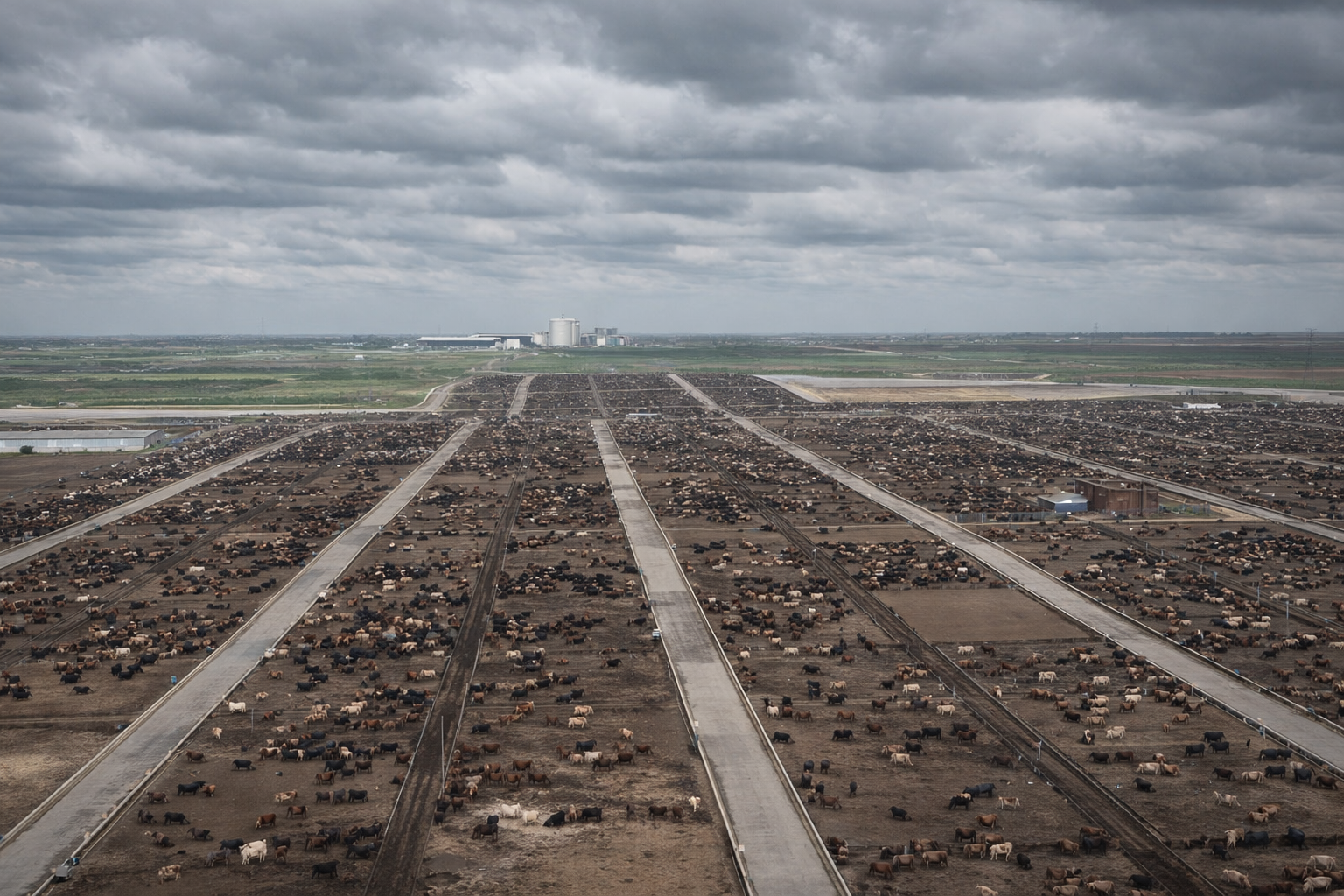
Lubbock Feeders: Seventy Years. Then the Dependence Broke.
For seventy years, Lubbock Feeders moved cattle across the South Plains like clockwork — until the feeder pipeline it depended on ran dry. When a closed border collided with the smallest U.S. herd since 1951, a 50,000-head machine discovered just how fragile modern cattle infrastructure has become.
For seventy years, Lubbock Feeders stood as one of the foundational engines of the South Plains cattle economy — a 50,000-head yard that fed more than five million cattle and anchored an entire local ecosystem of corn growers, truckers, veterinarians, packers, and labor.
It did not collapse overnight.
It simply reached the end of its pipeline.
For years, an estimated 60–70 percent of the yard’s inventory came from Mexican feeder cattle. That wasn’t a secret; it was embedded into the operating model of much of the Southwest feeding system.
When USDA-APHIS closed the southern border to live cattle imports following New World Screwworm detections in Mexico, the inflow that sustained that model stopped. The federal record shows the progression clearly: imports halted in late 2024, briefly resumed under enhanced inspection protocols in early 2025, then fully suspended again in May 2025. As of early 2026, the APHIS import page still lists southern livestock trade as closed.
At the same time, the domestic herd was already at historic lows.
USDA NASS reported January 1, 2026 cattle inventory at 86.2 million head — the smallest U.S. herd since 1951. Beef cows sit at their lowest level since 1961. The 2025 calf crop marks the smallest number since the 1940s.
So the collision becomes obvious.
An American feeding system built around steady cross-border inflows met the smallest native herd in three-quarters of a century. When the external supply stopped, there was no domestic cushion large enough to replace it.
The issue isn’t that the border closed.
The issue is that American infrastructure was positioned as though it would never close.
The parasite threat is real. New World Screwworm is not theoretical, and APHIS’ sterile insect program is publicly documented and historically validated. The United States eradicated the parasite once before at enormous cost. No serious cattleman argues for gambling with reintroduction.
But biosecurity exposed something deeper.
A feeding sector that once ran on domestic herd strength had gradually normalized reliance on imported cattle to maintain scale. When that flow vanished, fixed capacity turned from strength into liability.
A 50,000-head yard is not a flexible tool. It is a volume machine. Pens, mills, labor, debt service, and packer contracts are calibrated to throughput. Remove the throughput long enough, and the economics invert.
That’s what Lubbock Feeders represents.
Not a regulatory overreach. Not a hidden plot. A structural weakness.
Industry estimates suggest that without the Mexican feeder pipeline in 2026, Texas, Oklahoma, and New Mexico could lose roughly one billion pounds of regional beef production. That loss does not just hit the yard; it cascades through feed crops, trucking routes, packing shifts, and rural payrolls.
Once capacity disappears, it rarely returns in identical form.
Steel can sit. Land can sit. Labor does not.
The uncomfortable lesson is this: dependence is invisible until it is tested.
For decades, imported feeders masked domestic herd contraction and allowed feeding capacity to maintain a scale that native production alone could not support. When the valve closed, the mismatch was revealed.
If anything, Lubbock is not an argument for imports.
It is an argument for rebuilding domestic cow numbers, retaining heifers, strengthening regional finishing diversity, and refusing to let core American cattle infrastructure hinge on external supply.
The border did not collapse Lubbock Feeders.
Dependence did.
Sources:
- Lubbock Feeders closure announcement and Kyle Williams quotes (60-70% Mexican inventory, 70-year legacy, finish current cattle only): https://www.everythinglubbock.com/news/local-news/lubbock-feeders-announces-feedyard-closure-after-70-years
- Lubbock Feeders official site (still live, business-as-usual presentation, 50,000-head capacity): https://www.lubbockfeeders.com/
- USDA NASS Cattle report (Jan 1, 2026 inventory: 86.2 million head, smallest since 1951; beef cows 27.6 million, smallest since 1961; 2025 calf crop 32.9 million, smallest since 1941): https://www.nass.usda.gov/Newsroom/2026/01-30-2026.php
- USDA APHIS live cattle/bison imports from Mexico (southern border closed due to NWS as of Jan 13, 2026 update; confirmed ongoing Feb 2026): https://www.aphis.usda.gov/live-animal-import/cattle-bison-germplasm/mexico
- USDA APHIS current NWS status (Feb 19, 2026 last modified; active Mexico cases listed, all southern ports closed to livestock): https://www.aphis.usda.gov/livestock-poultry-disease/stop-screwworm/current-status
- USDA press release (May 11, 2025 full suspension reinstatement): https://www.usda.gov/about-usda/news/press-releases/2025/05/11/secretary-rollins-suspends-live-animal-imports-through-ports-entry-along-southern-border-effective
- TCFA Ben Weinheimer on ~1 billion lb regional beef loss in TX/OK/NM for 2026 without Mexican pipeline: https://www.oklahomafarmreport.com/2026/02/19/weinheimer-loss-of-mexican-feeders-could-cut-beef-production-by-a-billion-pounds
More in Business
-
 chevron_right
Red, White, and Bullsh*t Pt. 2: How the USDA Built a Marketing Campaign for a Label Nobody Has to Use
Mar 25, 2026 · Beef News
-
 chevron_right
Regenerative Agriculture in the Trump World: Farmers First is a Lie
Mar 16, 2026 · Beef News
-
 chevron_right
"No Guardrails. None.": How a Single SBA Size Standard Launders Big Ag Subsidies as Small Business Aid
Mar 11, 2026 · Beef News
-
 chevron_right
The Lock-In: Why Chemical Farming Survives 40 Years of Contrary Evidence
Feb 22, 2026 · Beef News