The Hourglass Is a Noose: How the Big Four Choke America’s Ranchers
R-CALF USA just told the U.S. Senate what ranchers have known for years: the Big Four meatpackers control 80% of the fed cattle market, and they’ve turned it into a bottleneck. Family-scale producers are being driven out while consumers pay more for beef that’s often imported and deceptively labeled. R-CALF’s message is clear—this isn’t a functioning market, it’s a cartel.
Updated: June 28, 2025
America’s ranchers are being choked out—not by drought, not by demand, but by design.
Everyone in the Food Freedom movement knows the meatpacking industry is dominated by the Big Four—Tyson, JBS, Cargill, and National Beef. What fewer realize is just how surgically they’ve weaponized that control.
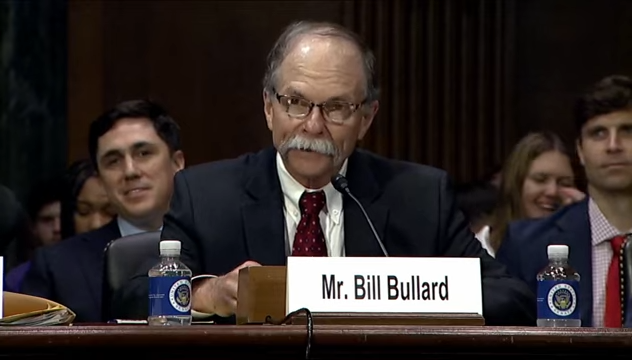
These four companies command over 80% of the U.S. fed cattle market—a level of consolidation that, in Bill Bullard of R-Calf USA’s words at a recent Senate hearing, has transformed America’s beef system from a competitive market into a corporate chokehold. The result isn’t just fewer ranchers. It’s a strategic bottleneck that’s bleeding rural America dry while inflating food prices for everyone else.
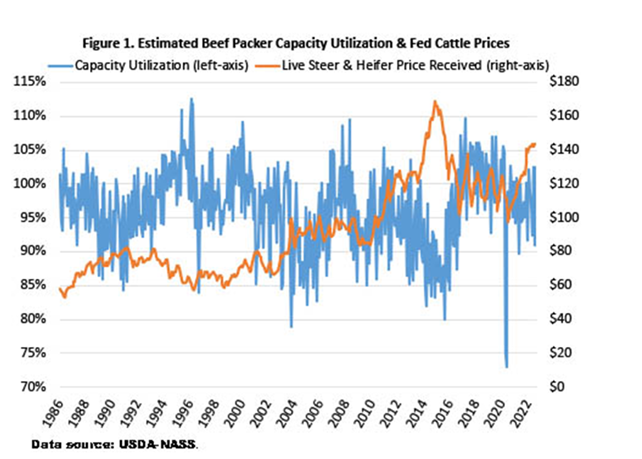
“No one looking at this chart can say our cattle and beef markets are functioning fine. Ranchers at one end of the supply chain and consumers at the other are being exploited.”
— Bill Bullard, R-CALF USA CEO, testifying before the U.S. Senate
Advertisement
The Rigged Structure: Hourglass Economics
In Senate testimony last week, Bullard described the current beef market as shaped like an hourglass: thousands of independent producers at the top, millions of consumers at the bottom—and four multinational gatekeepers in the middle.
For decades, these packers have benefited from what Bullard calls “de facto deregulation”—a long-running refusal to enforce the Packers and Stockyards Act or modern antitrust law. This has allowed the Big Four (Tyson, JBS, Cargill, National Beef) to squeeze both ends of the chain.
“Given their gatekeeper status and inherent market power, they are powerful oligopolies capable of exerting abuse of market power upstream into the cattle supply chain to reduce cattle prices paid to producers and downstream in the beef supply chain to increase consumer beef prices.”
The result? Over half of U.S. cattle ranchers have exited the industry, the U.S. cattle herd is the smallest it’s been in seven decades, and nearly two-thirds of sheep ranchers are gone.
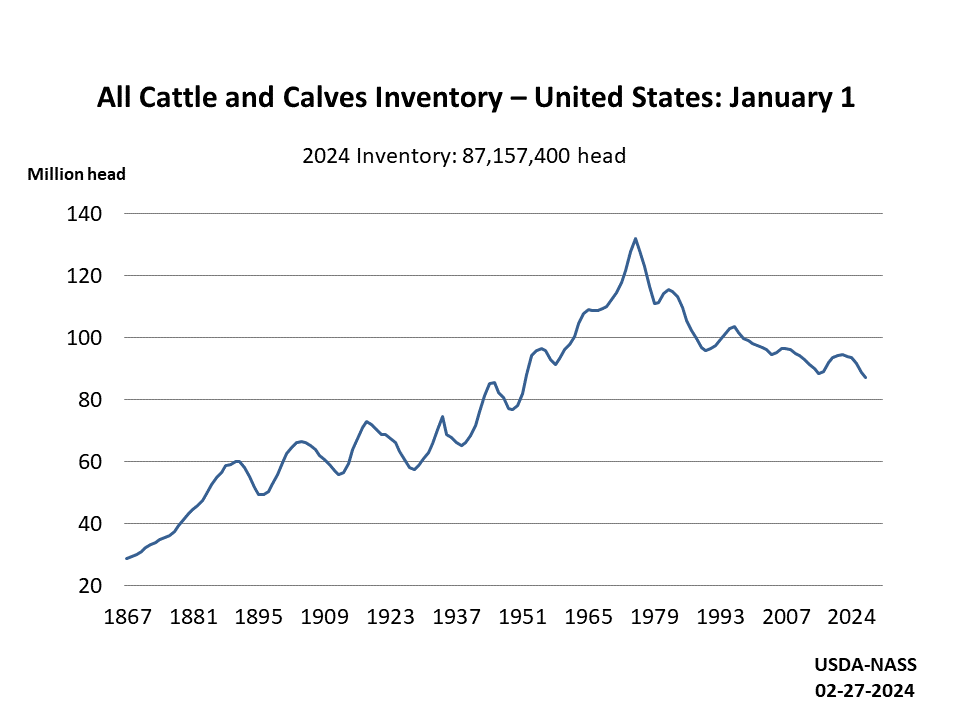
nass.usda.gov
USDA - National Agricultural Statistics Service - Charts and Maps - Cattle: Inventory on January 1 by Year, US
USDA National Agricultural Statistics Service Information. NASS publications cover a wide range of subjects, from traditional crops, such as corn and wheat, to specialties, such as mushrooms and flowers; from calves born to hogs slaughtered; from agricultural prices to land in farms. The agency has the distinction of being known as The Fact Finders of U.S. Agriculture due to the abundance of information we produce. The National Agricultural Statistics Service
How the Monopoly Works
Bullard laid out how the packers game the system:
- They buy cattle through four pricing mechanisms, but only the cash market sets the national base price.
- Today, that cash market makes up just 18% of trades—easily manipulated, and used to suppress prices across all channels.
- Meanwhile, 73% of lamb and 22% of beef consumed in the U.S. is imported, often relabeled as domestic due to a legal loophole.
“This is a broken market that caused consumers to pay ever-increasing beef prices while cattle prices were falling—a phenomenon that cannot be explained by competitive market fundamentals, particularly when one considers the only ingredient of beef is cattle.”
The Labeling Lie
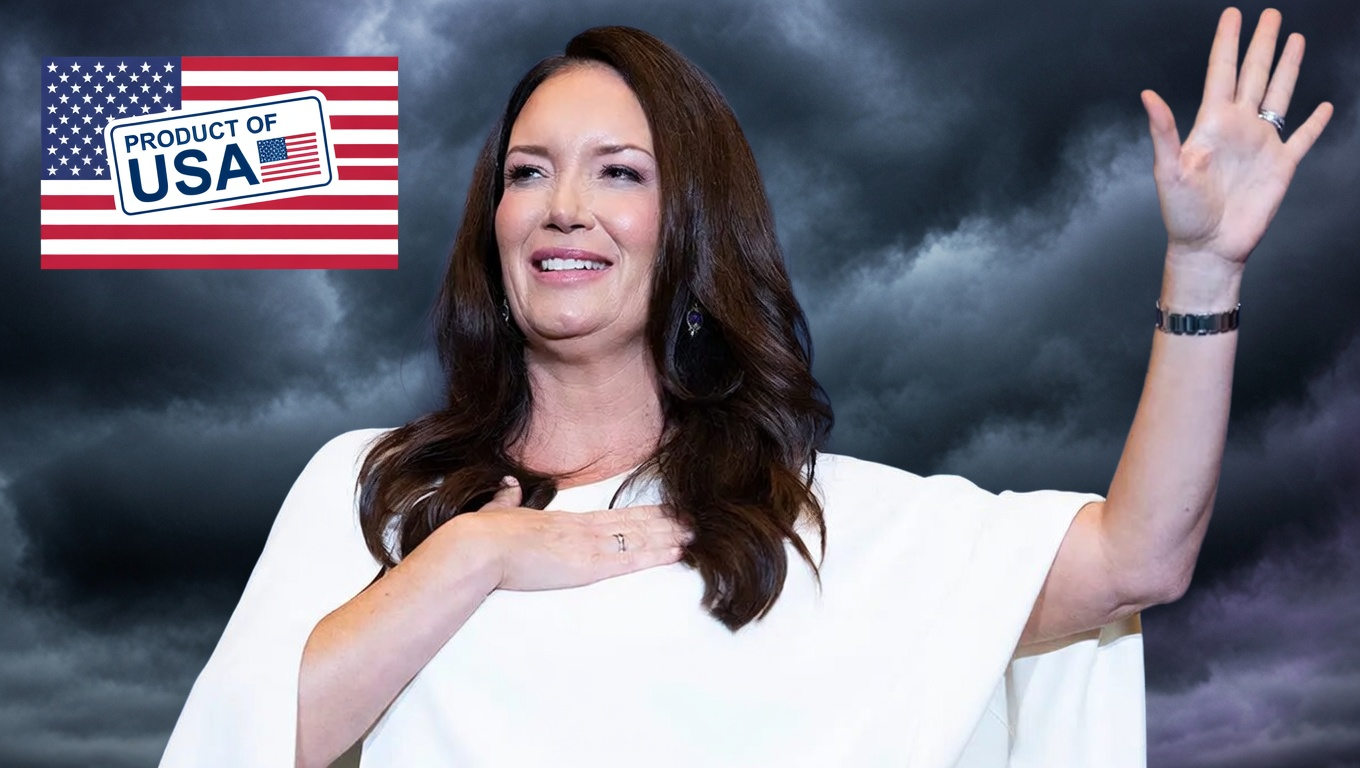
Thanks to Congress’s 2015 repeal of mandatory Country-of-Origin Labeling (MCOOL), multinational packers can import beef from Brazil, Argentina, or Uruguay—then rewrap it in a U.S. processing plant and label it “Product of USA.”
That’s not theory—it’s current policy. Bullard explained:
“Meat packers can import a product—say a steak from Uruguay—that has a ‘Product of Uruguay’ label on it when it crosses U.S. Customs. Then when it’s brought into a U.S. processing plant, the Uruguayan label can be thrown in the garbage, a new plastic wrapper affixed, and it can be sold with a ‘Product of USA’ label.”
The USDA has proposed a voluntary labeling rule set to take effect in 2026. But as Bullard noted, voluntary means meaningless—packers won’t use it unless compelled.
“Consumers are being deceived. They’re being exploited in the marketplace without mandatory country-of-origin labeling.”
Checkoff Extortion: The Rancher Tax Used Against Ranchers
Bullard also took aim at the federally mandated Beef Checkoff Program—a system that taxes ranchers $1 per head of cattle sold, ostensibly for beef “promotion and research.” In practice?
“The money’s been funneled through organizations that lobby on public policy issues that are contrary to the interests of independent producers.”
“Independent producers find themselves being forced to pay a tax on every head of animals sold, only to see the funds used in the halls of Washington to lobby against their interests.”
This includes lobbying against mandatory COOL and in favor of failed trade agreements like the TPP. Bullard endorsed the Opportunities for Fairness in Farming (OFF) Act as the necessary fix.
Where We Go From Here
Bullard’s demands to Congress were sharp and actionable:
- Finalize the Packers & Stockyards rules started under the Trump administration
- Fully enforce U.S. antitrust laws
- Restore mandatory country-of-origin labeling
- Pass the OFF Act to reform the corrupt checkoff program
“If we don’t take some immediate action in the form of regulatory relief, we will continue to see a loss of producers.”
Find your local rancher and cut the cartel out—visit BeefMaps.com to buy direct, eat honest, and break the bottleneck.
More in Business
-
 chevron_right
Red, White, and Bullsh*t Pt. 2: How the USDA Built a Marketing Campaign for a Label Nobody Has to Use
Mar 25, 2026 · Beef News
-
 chevron_right
Regenerative Agriculture in the Trump World: Farmers First is a Lie
Mar 16, 2026 · Beef News
-
 chevron_right
"No Guardrails. None.": How a Single SBA Size Standard Launders Big Ag Subsidies as Small Business Aid
Mar 11, 2026 · Beef News
-
 chevron_right
Lubbock Feeders: Seventy Years. Then the Dependence Broke.
Feb 24, 2026 · Beef News